
For more than two centuries, the Steenvoorde Philharmonic Society has played a central role in the life of the town. Present at local festivals, official ceremonies and major cultural events, it has preserved a musical tradition that is recognised far beyond the municipality. Discover the history of this emblematic association, its conductors and the generations of musicians who have contributed to its reputation.
The Steenvoorde Philharmonic Society: More Than Two Centuries of Musical Tradition
Founded in 1806 by former military musicians from Napoleon's army, the Steenvoorde Philharmonic Society is one of the oldest associations in the municipality. For more than two centuries, it has accompanied official ceremonies, local festivals, carnivals and the town's major events while passing on a passion for music to successive generations of musicians.
The Origins of Music in Steenvoorde (1806–1878)
Music in Steenvoorde began in 1806, during the administration of Pierre-Auguste Beck. In 1820, it became the National Guard Band, marking the beginning of its official organisation. The first known conductors were Pierre Salan and later A. Devet, while Joseph Beck played an important role in its development.
From 1858, Louis Verbeke took over the leadership of the Society. Under his direction, the band made rapid progress, achieved success in numerous competitions and earned a solid reputation. On 8 June 1878, the filing of its statutes officially established the Steenvoorde Philharmonic Society.
The Golden Age of Competitions (1878–1914)
At the end of the nineteenth century, the Philharmonic entered a particularly prosperous period. Under the direction of Louis Verbeke, and later Charles Davion, it won numerous awards at competitions and music festivals in France and Belgium.
In 1898, Louis Verbeke was appointed an Officer of the Academy, recognising nearly forty years devoted to leading the Society. After his death in 1901, Charles Davion, who had served as assistant conductor since 1887, succeeded him and continued the Society's development until the outbreak of the First World War.
The Wars and the Revival (1914–1945)
The First World War brought the Society's activities to an abrupt halt. Ten musicians lost their lives for France, and its conductor, Charles Davion, also died during this period.
Music lessons resumed in 1919. The Society was re-established in 1920 with Paul Debruyne as Musical Director, before Jérôme Peel took over the position in 1922. Under his leadership, the Philharmonic quickly regained its momentum and once again became a regular participant in regional music festivals.
In 1936, Robert Théry was appointed conductor. Despite the Second World War, he continued to train young musicians and played a key role in the Society's revival after the Liberation.
Renewal and Recognition (1945–1980)
Under the leadership of Robert Théry, the Steenvoorde Philharmonic Society entered a new period of growth. The music school trained a new generation of instrumentalists, membership increased, and the repertoire expanded to include major classical works. Thanks to its high musical standards, the Philharmonic earned a reputation that extended far beyond the borders of Steenvoorde.
In 1970, the Society celebrated its 150th anniversary. In 1978, after forty-two years at the head of the orchestra, Robert Théry handed over the baton to Daniel Francke.
A Living Tradition (Since 1980)
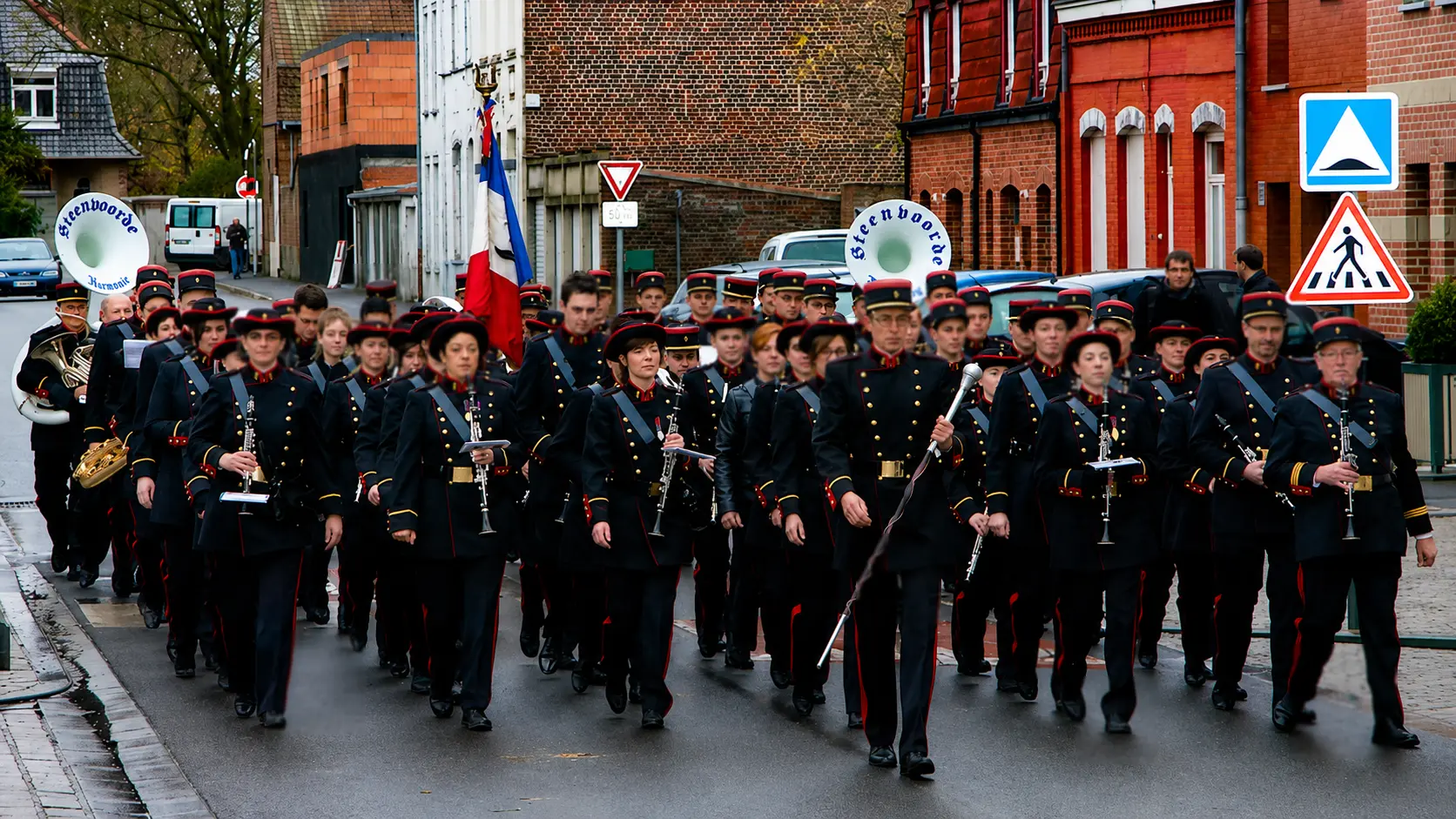
The musicians of the Steenvoorde Band wearing military-inspired uniforms during an official parade.
Under the direction of Daniel Francke, the Steenvoorde Philharmonic Society continued to develop and strengthened its ties with other musical ensembles. In 1980, it celebrated its 160th anniversary by organising a major gathering of fellow music societies. On that occasion, 25 concert bands and philharmonic societies from France and Belgium brought together more than 1,550 musicians in the streets of Steenvoorde, making it one of the most significant events in the Society's history.
In 2011, Nicolas Decroix succeeded Daniel Francke as conductor of the Steenvoorde Philharmonic Society. Trained at the conservatories of Lille and Amiens, he is a clarinet teacher and Director of the Steenvoorde Municipal Music School. He has devoted his expertise to training young musicians and supporting the Philharmonic's artistic development.
Today, the Steenvoorde Philharmonic Society brings together nearly 80 musicians and performs a varied repertoire ranging from classical masterpieces to works written for concert band, as well as film scores and musical theatre. Its spring gala concerts, St Cecilia's concerts, carnival performances, official ceremonies and local events all reflect a musical tradition that remains as vibrant as ever.
Thanks to the work of the Municipal Music School, the future of the Society is assured. Young musicians regularly join the Philharmonic and demonstrate the quality of their training through successful performances in competitions and musical events. More than two centuries after its foundation, the Steenvoorde Philharmonic Society remains a leading force in the town's cultural life, preserving a tradition of musical excellence, fellowship and service to Steenvoorde's heritage.
With more than two centuries of history, the Steenvoorde Philharmonic Society continues to keep music alive, train new generations of musicians and contribute to the town's cultural influence, remaining faithful to its motto:
“Art • Unity • Charity”
Contact
Société Philharmonique de Steenvoorde
Maison des Flandres
Place du Dr Jean-Marie Ryckewaert
59114 Steenvoorde
🌐 Site officiel : www.musique-steenvoorde.fr
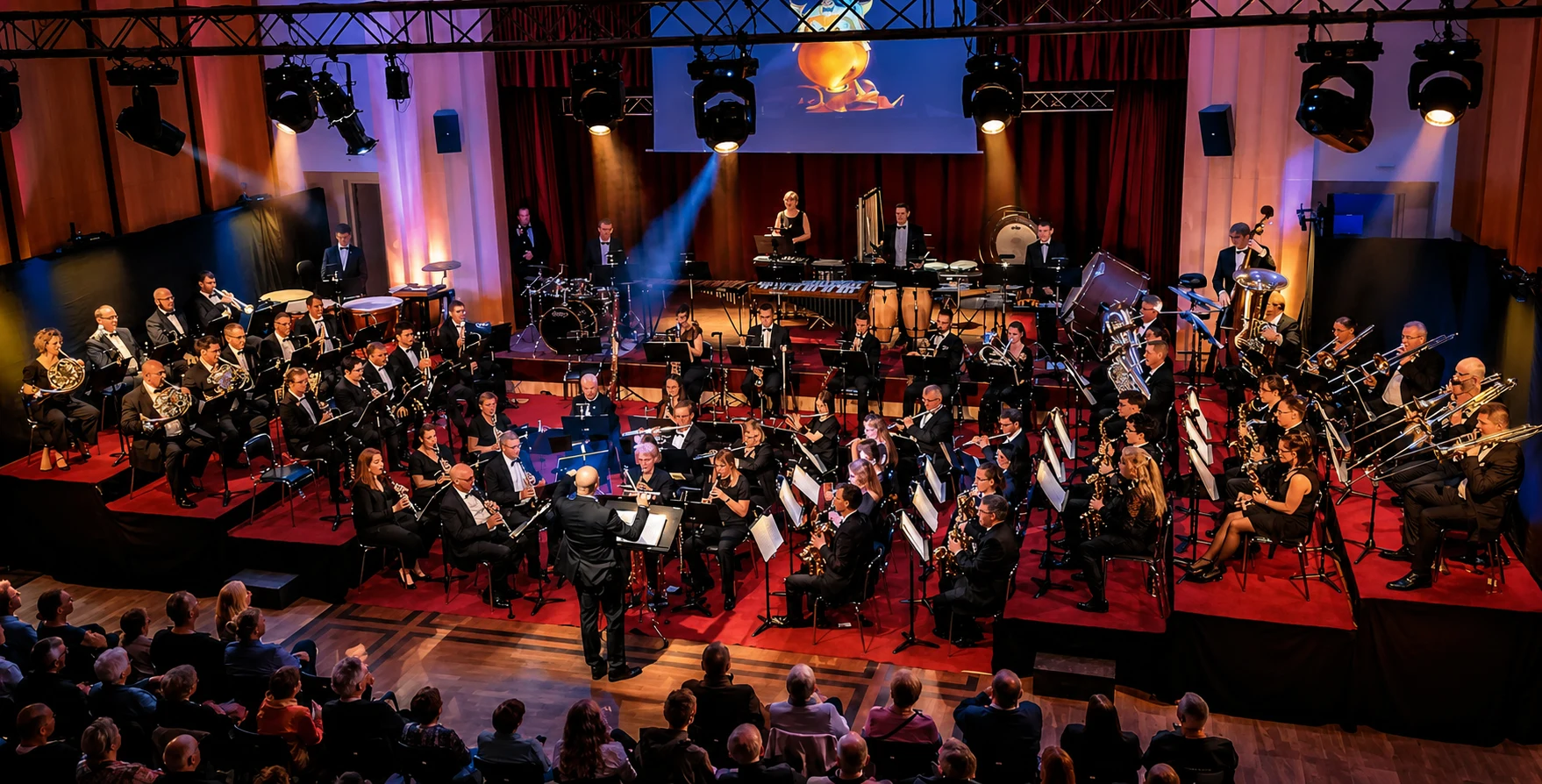
The Steenvoorde Philharmonic Society during a gala concert, continuing more than two centuries of musical tradition at the heart of the town.
“A Giant who does not dance is a Giant who does not live… Without music, a Giant carried on the shoulders does not dance”
"Belle Hélène", the Giant's Anthem
To mark the 2015 Ducasse of Processional Giants, the Steenvoorde Philharmonic Society unveiled "Belle Hélène", a composition written by its conductor, Nicolas Decroix, to celebrate the giant's anniversary. Since becoming her official anthem, the piece has been performed at the major events organised by the Les Amis de Gambrinus association.
"Grand Constant", Jean le Bûcheron's Anthem
The Steenvoorde Philharmonic Society also accompanies the major events of the Carnival and celebrations honouring the processional giants. Among its most emblematic works is "Grand Constant", the official anthem of Jean le Bûcheron.
Performed during the final rigodon, this piece accompanies the giants' dances and brings together bearers, musicians and spectators in a festive atmosphere. Today, it is an integral part of Steenvoorde's Carnival traditions and popular heritage.
Jean le Bûcheron's Anthem – 1977 Audio Recording
The Philharmonic Society at the heart of the Flemish festivities
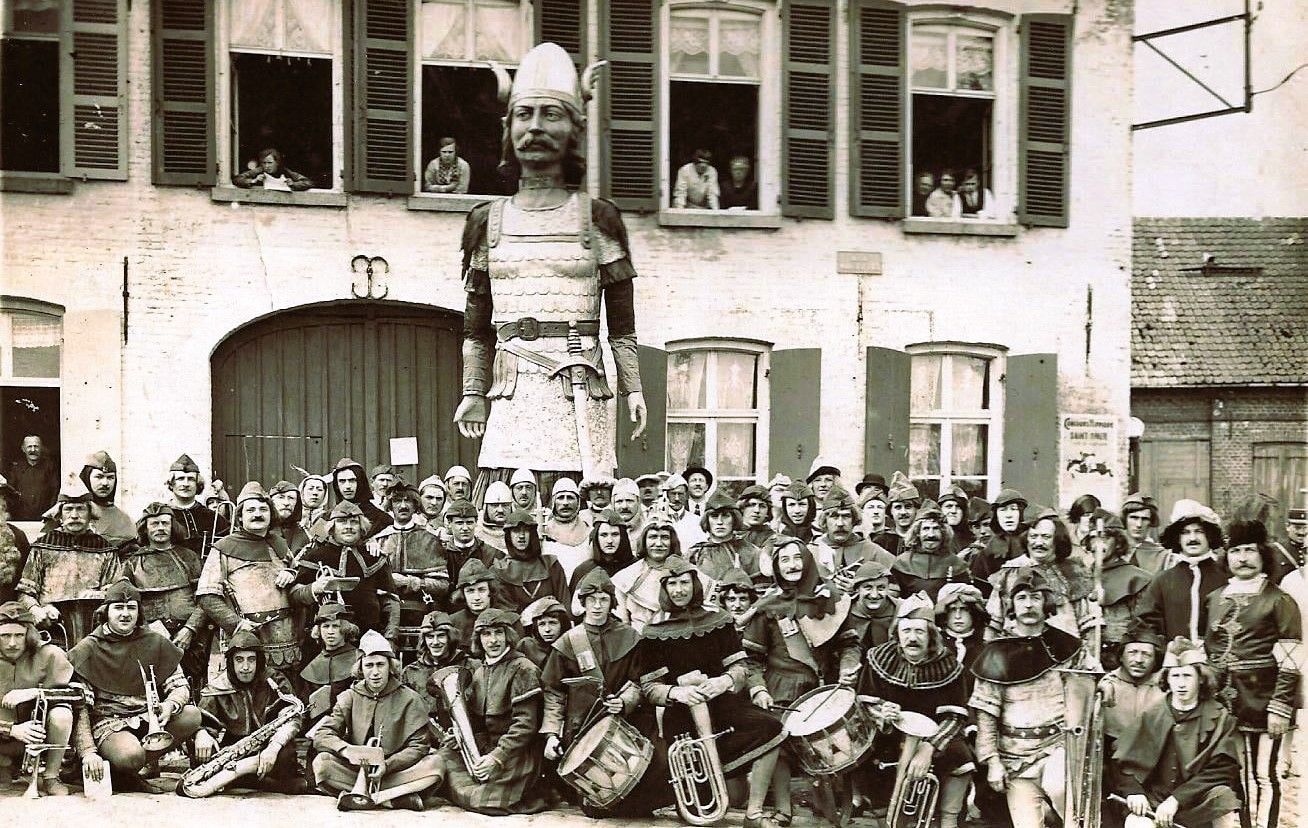
This group photograph shows the musicians of the Steenvoorde Philharmonic Society during the festivities held in Cassel on 8 July 1928 to mark the unveiling of the monument dedicated to Marshal Foch. On this occasion, a grand parade brought together nearly thirty giants from French Flanders and Belgium. The presence of the Steenvoorde Philharmonic Society highlights the vital role of music during these grand festive occasions, when brass bands, marching bands and giant figures brought the streets of towns and villages to life.
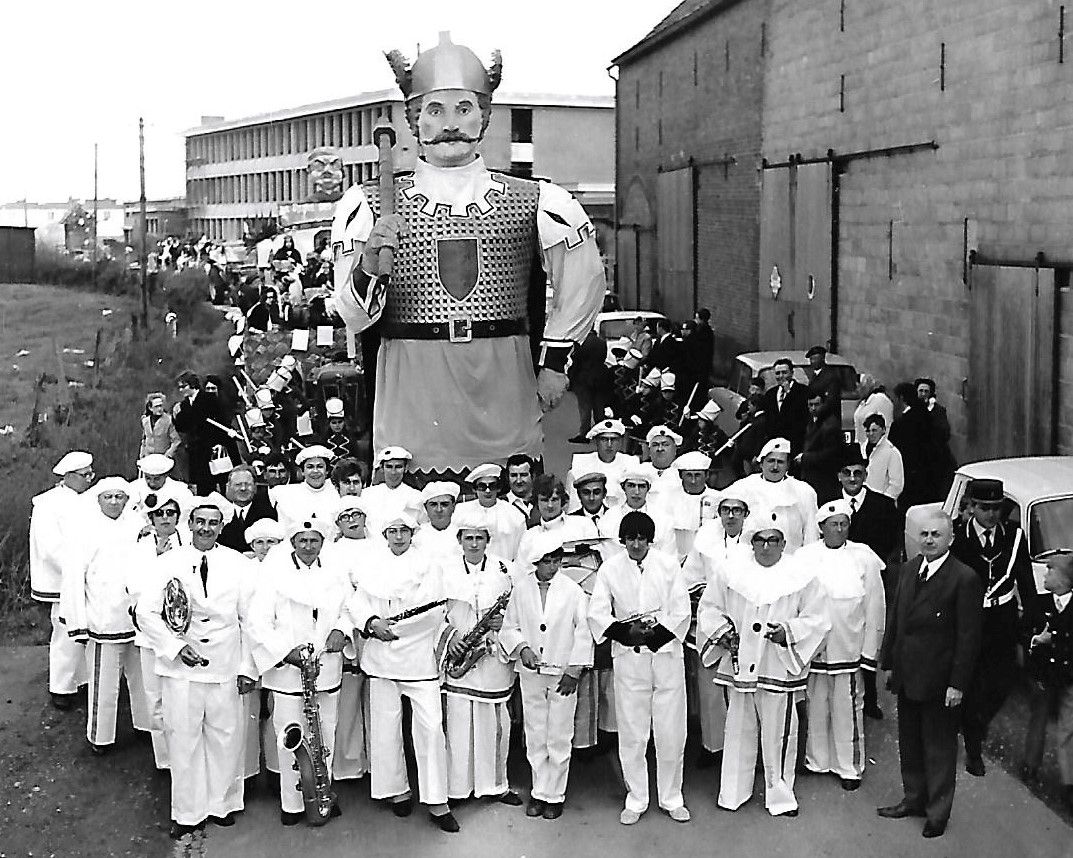
Published in *La Voix du Nord – Hazebrouck* on 25 April 1981, this photograph shows the musicians of the Steenvoorde Philharmonic Society gathered around Jean le Bûcheron. It bears witness to the close links between music, the giants and the festivities in Steenvoorde.
The names of those pictured were identified thanks to Michel Haverbeque and Georges Delaeter, two musicians featured in the photograph.
Front row, from left to right: Ernest Delaeter, Michel Couture, Maurice Sénéchal, Gilbert Gilloots, Raphaël François, Félix Vuylsteker, Georges Delaeter, Louis Cahon, André D’Haudt, Henri Ruckebusch, Marcel Delaeter, Paul Spilmacker, Joseph Ruckebusch, Arthur Denaes, Michel Deram, Paul Delaeter and Rémi Poissonnier.
Back row, from left to right: Jules Delaeter, Léon Vuylsteker, Félix Cappelaere, Cyrille Deschuytter, Jules Pladys, Michel Haverbeque, Robert Théry, Georges Varey, Maurice Meese, André Dereeper, Cyrille Couture, André Vannobel, Maxime Pollet, Jules Maes, Albert Decoster, Maxime Bry, Lucien Gilloots, André Maes, Roger Hollande, Jérôme Peel, Roger Wyart, Paul Leduc and César Gilloots.
At that time, Jérôme Peel was the director of the Steenvoorde Philharmonic Society. César Gilloots, founding president of the Friends of Fromulus, was also one of the promoters of *Jean le Bûcheron*, a play modelled on him.
In the third row, from left to right: Michel Verhille, Raoul Barigel, Auguste Verhille, Daniel Declerck, Albert Delewil, Michel Pladys and René Six.
Continue your exploration
The Steenvoorde Philharmonic Society has been a part of the town’s festivals and major events for generations. Discover the history of the Steenvoorde Carnival, the figures of the Giants of Steenvoorde and the story of Jean le Bûcheron, whose anthem ‘Grand Constant’ accompanies the final rigodon. You can also discover the ‘Friends of Fromulus’ and ‘Friends of Gambrinus – La Belle Hélène’ associations, as well as the Steenvoorde Carnival Archives dating back to 2003.

A website dedicated to the Giants of Steenvoorde, their history, their associations and the Summer Carnival.
© 2023 / 2026 – Steenvoorde and its Giants
Legal notices: Website hosted by planethoster.fr
Design: Pascal Cnockaert
Documentation and archives
The information presented on this website is based on public archives, historical publications, press articles, photographic collections, oral accounts and heritage resources relating to the history of Steenvoorde, its giants and its carnival.
Traduction automatique Deepl