
Gambrinus, the king of beer and hero of Steenvoorde
A popular hero of Flanders and the legendary king of beer, good old Gambrinus holds a special place in the Flemish imagination. In Steenvoorde, a tradition tells how this valiant knight from Brabant won the heart of the beautiful Guenièvre through an extraordinary feat, combining strength, courage and conviviality.
Rediscovered by chance amongst old papers yellowed by the passage of time, this legend inspired the creation of the Giant Gambrinus and gave its name to the association Les Amis de Gambrinus.
The Legendary Tale of the Giant Gambrinus
Fifty years ago, Jan de Schoenmaker had warded off the grave threat posed by the Norman invasion from the market town of Steinfort. Ever since that day, the inhabitants had lived happily and prayed ceaselessly to Saint Peter, the town’s patron saint, to thank him for having blessed them with a cobbler brimming with courage and humility.
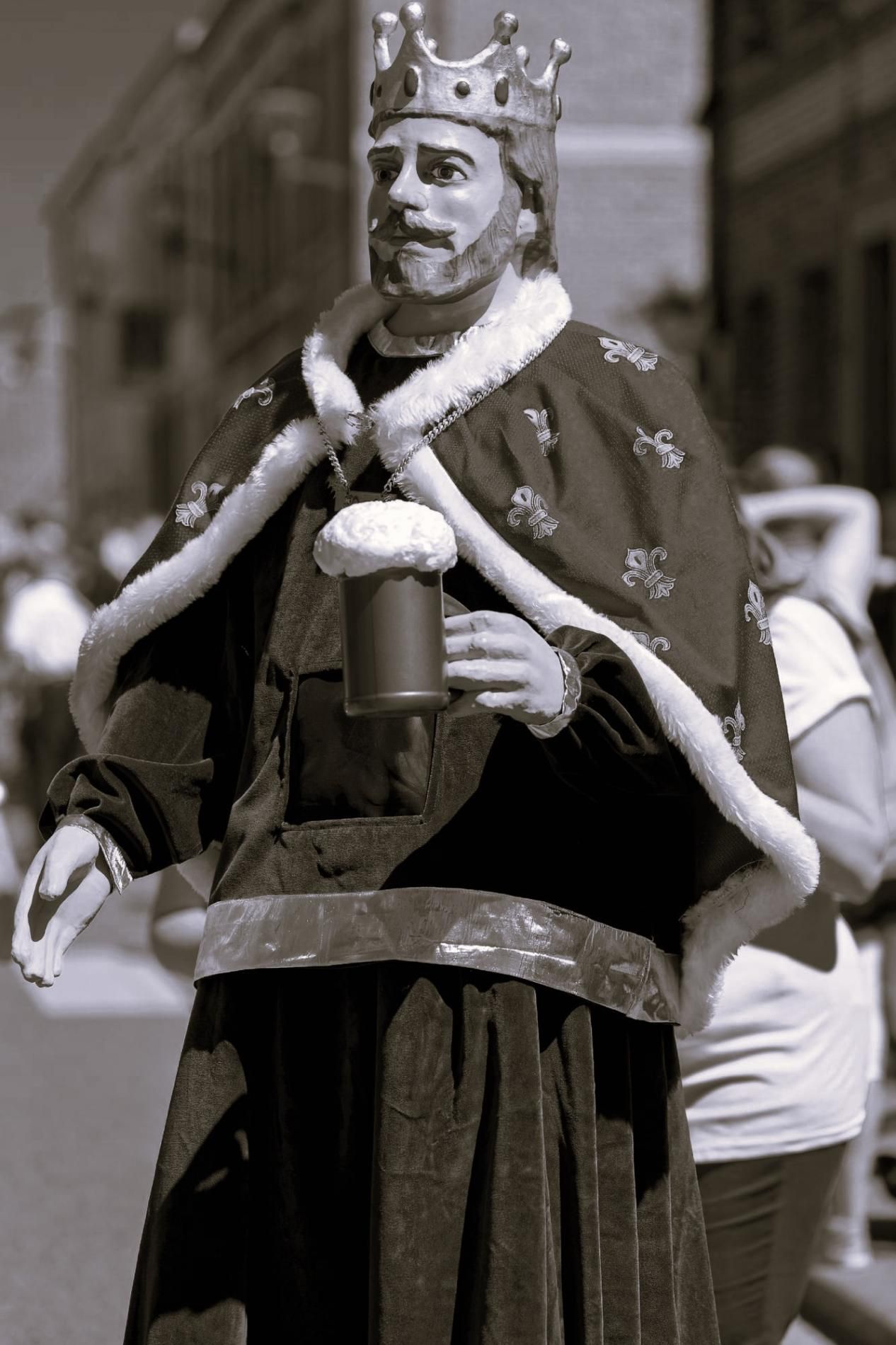
Gambrinus the Mini-Giant – Photo : Daniel Decoune, Land of Giants.
The atmosphere in the village was calm and serene. Steinfort was then enjoying its golden age. The harvests were bountiful and the lord of the village ruled with wisdom and loyalty. His name was Modred the Just, a direct descendant of Thibaut the Bold, and he lived peacefully with his wife and his daughter Guinevere, who was radiant with beauty.
She was slender. Her radiant complexion highlighted the grace of her face. Her hair, as blonde as ripe wheat, fell to her hips like a fine shower of gold.
Alas, such beauty could not conceal an unfortunate flaw. Just as a blemished fruit no longer attracts the greedy hand, so Guenièvre found herself alone, devoid of gallant company. She was immensely capricious, and her parents indulged, as best they could, her every desire, for she alone could carry on the line of the lords of Steinfort.
Now, one fine summer’s day, she rose at the break of dawn, went to fetch her father and said to him in a tone that was part plea, part command:
‘Father, I wish to be married on Saint Léger’s Day, not to Sir Goblin, Grand Chancellor of the Châtellenie of Cassel, as you intend, but to a knight who, after drinking my weight in beer, will manage to lift with one hand the splendid steed upon which I shall sit.’
At these words, Modred the Just could only respond with a nod, so utterly did this whim surpass anything he could ever have imagined. He therefore sent messengers from castle to castle to proclaim the news.
It so happened, by a twist of fate known only to destiny, that a group of lords were staying a few leagues from Steinfort, at the home of the Lord of Watou. He was treating them to the fine beer of which they were so fond. As soon as Modred’s messenger had proclaimed his message to the lord and his guests, they took their leave of their host as quickly as possible and set off in great haste for Steinfort, spurred on by the delightful prospect of this marriage.
Among these knights was a man capable of fulfilling the conditions set by Guinevere. He alone embodied the qualities necessary to achieve this feat.
He was built like an oak. The bulging muscles of his limbs were as thick as a beer barrel. His shoulders, six feet and three inches across, supported a head whose features, though rugged, inspired sympathy. Jet-black hair framed a ruddy face, at the centre of which stood a nose curved at the tip, resembling the tendrils of a hop plant running along its stem. His brown eyes sparkled with courage, and a similarly curly moustache adorned a face that exuded good nature.
This rugged fellow was called Jean Primus, Duke of Brabant, more commonly known as ‘Gambrinus’.
By the time they caught sight of the church tower, the day was drawing to a close and their first concern was to find lodgings for the night. The inn on the outskirts of Steinfort, along the road leading to the Kasselberg, seemed welcoming to them, and they settled in there. During the night, the innkeeper ran out of beer, such was the knights’ unquenchable thirst.
Gambrinus was surrounded by the greatest number of empty barrels when he was woken the next morning by Ayman, a former pirate turned brewer, who had come to fetch them.
Once the bell had struck ten times, the suitors presented themselves at the castle gates. From there, they were ushered into a great hall. A few moments later, Modred the Just, his wife and his daughter came to take their places amongst them. He invited them to a hunt in the woods of Beauvoorde, followed by a feast where the game they had bagged would be enjoyed, washed down with a flood of beer.
The hunt and the exploits of Gambrinus
Gambrinus particularly distinguished himself that afternoon by bringing down numerous stags and wild boars. He brilliantly demonstrated his mastery of the bow and arrow, as well as that of the sling.
In the very heart of a thicket, the beaters flushed out an enormous, raging wild boar. All the courtiers retreated, except Gambrinus.
Using his sling, he hurled a stone with such force and skill that the beast collapsed instantly, its skull split open. This feat caused quite a stir and cemented the knight’s reputation for courage, though he was also a man of great sensitivity, as was to be seen later.
He was lying in wait and was about to shoot when a doe burst out of a bush. Immediately, Gambrinus ordered no one to aim at her and shot his arrow into the air to startle her and let her escape.
This thoughtful gesture greatly pleased Guinevere, who thanked him with a promising smile that no one had ever seen play upon her lips before.
The following day was devoted to rest and preparations for the festivities. Dawn broke very early on the horizon and the town’s streets came to life first thing in the morning.
Saint-Léger’s Day promised to be a particularly fine occasion. The first rays of the sun set the banners bearing the coat of arms of Flanders ablaze. They adorned the entire square, where shrewd merchants displayed their fabrics and wares, knowing that the crowds would flock to the town for this exceptional day.
From the balconies of the houses in Steinfort, one could make out in the distance the undulating shapes of the tall crests majestically crowning the competitors.
They arrived from all directions, followed by their squires and companions. The Lord of Watou was the first to appear, and the castle courtyard was soon filled with the colours of the coats of arms and retinues of the lords present.
The most notable arrival was that of the Grand Chancellor of Cassel, heralded by triumphant trumpet fanfares. He was preceded by a considerable number of knights, whose gleaming armour emphasised their imposing bearing.
The sundial read half past eleven when, at the far end of the courtyard, our Gambrinus appeared last of all, dressed in simple attire. He took his place alongside his rivals amid the sniggers of Sir Goblin.
Modred the Just welcomed them and clearly set out the rules of the contest.
After clapping his hands twice, a long line of pages emerged from the far end of the courtyard, carrying bocks and barrels so that the contest could begin.
It was announced that fifty-five pints had to be consumed to pass the first round. At first, the mugs were emptied quickly and no contestant really stood out. But as the sun rose higher in the sky and the level of beer in the barrels dropped, the number of contestants dwindled.
Some gave up, their heads buried in their barrels, so drunk were they.
Only Sir Goblin, the Lord of Watou and the Duke of Brabant reached the bottom of their barrels after a good hour’s hard labour.
Without wasting any time, a squire brought Guinevere’s horse, adorned with white feathers. Silence fell amongst the crowd as the princess mounted her steed.
Sir Goblin, by virtue of his rank, had the right of precedence and stepped forward first to put his strength to the test.
After a moment’s thought, he let out a loud cry and abruptly lifted the animal. The spectators cheered the knight, who already believed himself the victor. He rode past the VIP stand, where Modred the Just congratulated him. Then he went to taunt the other two contenders, eyeing them up as though he were choosing an animal for his herd.
Next came the turn of the Lord of Watou, who staggered forward with great difficulty. Before performing his feat, he tried to salute the princess, but he suddenly nodded off and lost consciousness, falling against the horse’s hooves.
The squires splashed water on his face to wake him, so that he might make way for the final contestant.
Everyone was already counting Goblin as the winner, for no one thought Gambrinus could do any better.
Gambrinus’s feat, the marriage and the birth of the legend
When he reached the horse, he made no speech and, to everyone’s astonishment, without the slightest hesitation, he lifted Guinevere and her horse.
Having accomplished this feat, and continuing to carry his burden to secure victory once and for all, he made his way towards the stands where Father Jérôme was standing, tasked with pronouncing the nuptial blessing.
The abbot was amazed by the hero’s feat and blessed him at once. Then he implored him to allow Guinevere to dismount, so great was his fear at the scene. Everyone had noticed his fear, for every time a competitor undertook the trial, he would hastily cross himself and close his eyes, murmuring prayers.
Thus, Gambrinus’s daring had been proven.
Modred the Just then proclaimed his daughter’s marriage to the cheers of the crowd. As for Sir Goblin, embittered by his defeat, he set off as quickly as he could back towards the Kasselberg.
Gambrinus was then asked whether he felt able to make his way to the church so that the ceremony could be held immediately, as everyone feared that Guinevere might change her mind yet again.
He replied with a vigorous nod accompanied by a hearty ‘Yes!’, and the wedding procession set off.
Abbot Jérôme was already congratulating himself on the successful outcome of the contest and imagining the hundreds of gold coins that would soon fill the offering trays.
The ceremony was brief, at the request of the new husband, who preferred the pleasures of good food to the grand pomp befitting his rank.
As they left the church, Gambrinus took Guinevere in his arms and carried her, light as a feather, back to the castle.
From that moment on, the festivities began and continued until the other knights had regained their senses and their strength after the beer trial.
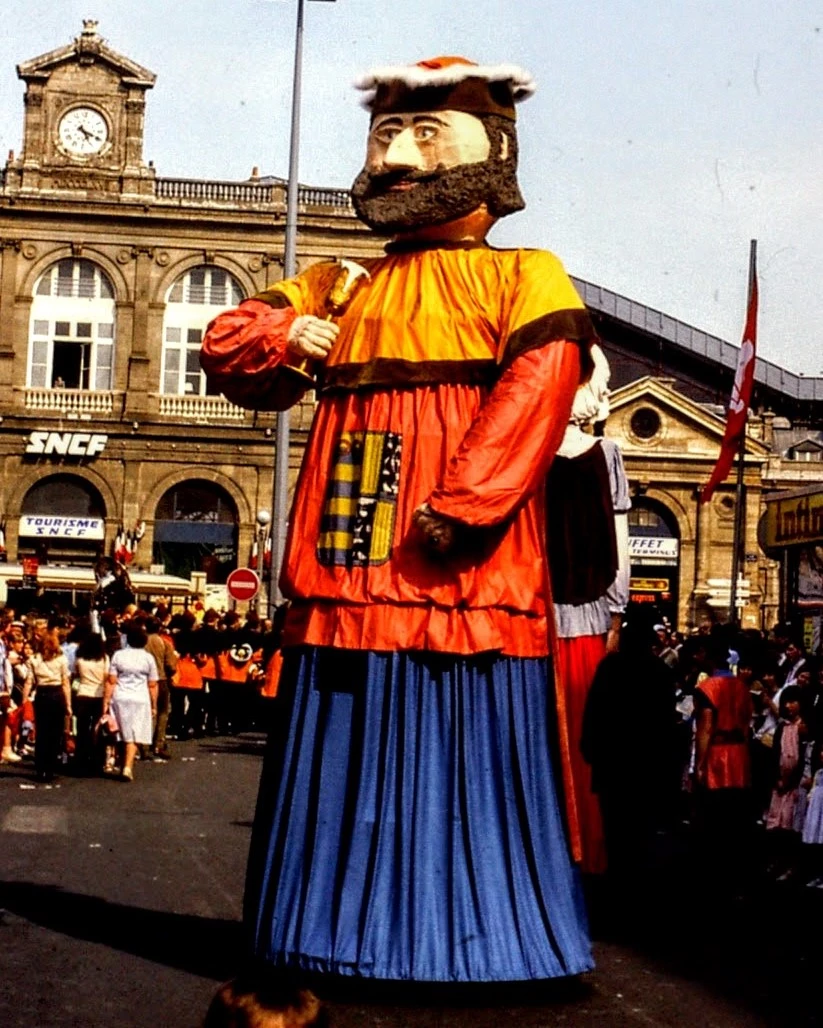
Gambrinus the Great 1982
Gambrinus’s legacy: the birth of the land of hops
From that day onwards, the town of Steenvoorde remained grateful to beer, and hop fields stretched as far as the eye could see, their regular furrows winding at the foot of tall, cooling foliage with mysterious depths, inviting one to dream.
Hops became a traditional crop, and the farmers learnt to live joyfully to the rhythm of their ‘Beer Harvest’.
When the god Gargantua, one day overcome by thirst, decided to sow hops on our fertile land, he cast a beneficial spell over the region.
It is certainly to him that the people of Flanders, who are not particularly favoured by the climate, owe their jovial temperament, much like that of Gambrinus: austere in appearance, yet deeply bon vivant and courageous.
It was by the same chance that led Gambrinus to Steenvoorde that this legend was discovered amongst old papers yellowed by the passage of time.
Captivated by the tale of these remarkable exploits, a group of young people decided to bring this character—who so perfectly embodies the spirit of the North—back to life and to keep his memory alive at every Hop Festival, which coincides precisely with Saint Léger’s Day.
Michel.M & Pascal.C - August 1977
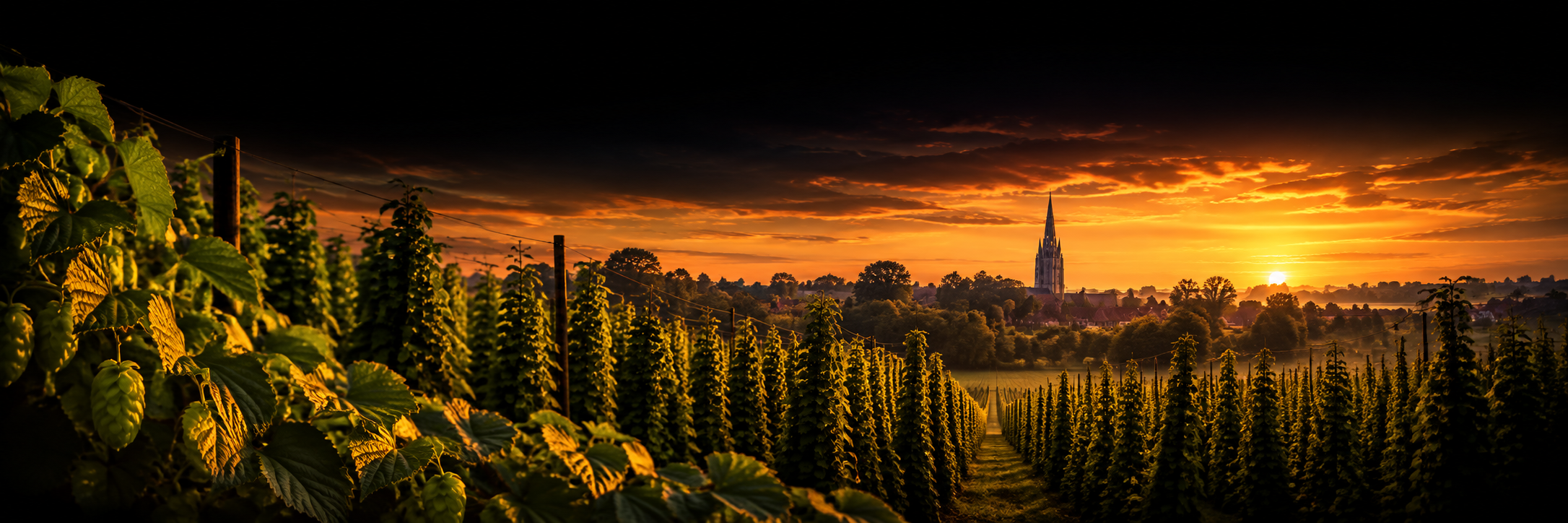

A website dedicated to the Giants of Steenvoorde, their history, their associations and the Summer Carnival.
© 2023 / 2026 – Steenvoorde and its Giants
Legal notices: Website hosted by planethoster.fr
Design: Pascal Cnockaert
Documentation and archives
The information presented on this website is based on public archives, historical publications, press articles, photographic collections, oral accounts and heritage resources relating to the history of Steenvoorde, its giants and its carnival.
Traduction automatique Deepl