
Everyone knows Rosalie, the milkmaid from Ryveld. But who knows the origin of this Giantess?
In his book ‘The Legend of Rosalie the Giantess of Ryveld’, drawing on the oral heritage of the elders of the time, Michel Loosen provides concrete details of the Giantess Rosalie’s early days. The book also reveals the tragic end of the Giantess at the hands of her creator.
Rosalie, the ephemeral giantess
In Ryveld, a hamlet of Steenvoorde, situated about four kilometres from the latter town, as the older residents of Ryveld recall – and we know that people have lived in this corner of French Flanders for a long time – in Ryveld, I say, no one had ever seen anything like it before!
It must have been in 1934—perhaps before, perhaps after; no one knows exactly anymore—but certainly on a Carnival Monday that ‘Rosalie’, the first Giant of the area, made her debut, surrounded by a crowd of delighted supporters, but also by a few sceptical jokers, not shy of ill-judged taunts and cutting remarks in Flemish – for everything was taking place in that language – such as:
“kykt ekee daa’, z’es krom en z’es mager lyke e stock”! Look at her, she’s crooked and as skinny as a stick!
Or even:
“z’hed e leuke beulte”! She’s got a hideous hump!
That wasn’t true, and in the face of these shameful, despicable slanders, let’s talk a little about those who’d had the idea of creating ‘Rosalie’.
The witnesses questioned, despite their often failing memories – after all, these events date back some 60 years! Unanimously, they stated that the man who’d had the idea of designing a Giant, and then bringing her to life, was Henri Lecleire, alias Try, who lived on Rue du Marabout – a lane so named because it was once home to a few gossipy old ladies, who used to chatter away over a coffee pot!
Henri Try was an artist in his own right, an accomplished craftsman, gifted with an obvious flair for invention coupled with a touch of fantasy and poetry. His patience was legendary and his perfectionism at work was taken almost to the extreme. Consequently, he found it hard to accept a helping hand, and as a result, what he created with his skilful fingers was nothing short of masterful.
Welcome Refreshment – Painting by César Pattein – 1901
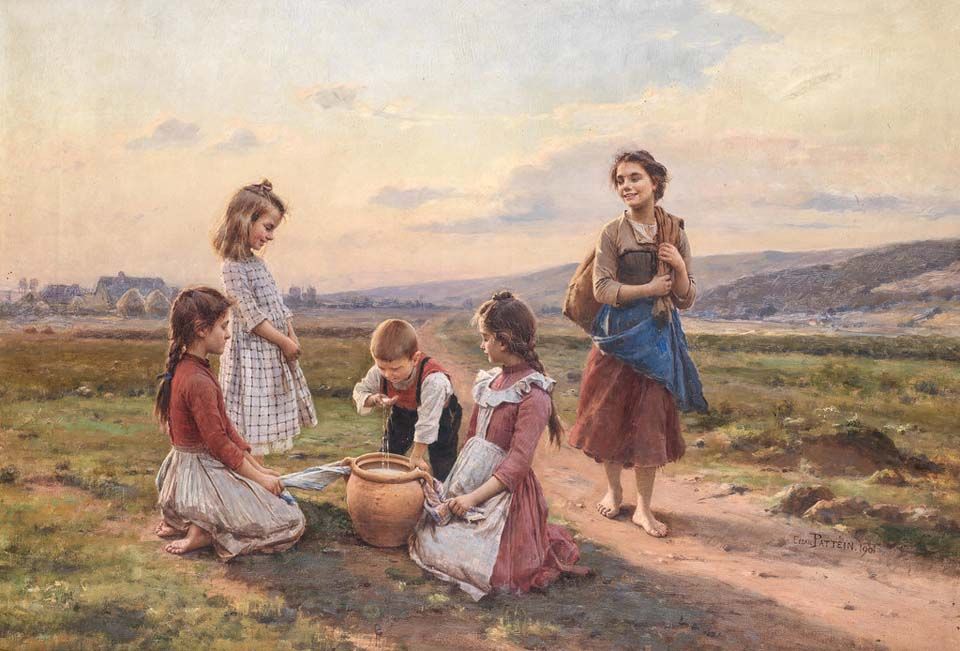
The outfit, colours and features of Rosalie (2024) are inspired by the paintings of César Pattein, a painter from the hamlet of Le Ryveld
So Henri had decided to build a ‘Géante’ and, right from the start, to call it ‘Rosalie’; like all young people of the time, he had been influenced by a song, then in vogue and very popular, called – of all things – ‘Rosalie’!
For Henri, creating a ‘Géante’ was, after all, a ‘first’, and, though a little apprehensive about such an undertaking, he nevertheless accepted the help offered by his brothers: Émile, nicknamed ‘Broere Try’ (pronounced ‘Broure’), meaning ‘Brother’, and Roger.
But, little by little, a band of merry companions gathered round Henri, the Artist, eager to have a good laugh in the most convivial of atmospheres.
Excerpt from the book *The Legend of Rosalie, the Giantess of Ryveld* by Michel Loosen (1993)
Rosalie, she’s gone
(Popular song from the 1930s)
Rosalie, she’s gone And ever since that day, I’ve been lovesick. Where is she? My heart calls out to her. If you see her, bring her back to me. For I’m under, I’m under, I’m under, I’m under her spell, My eyes are soft, are soft, are soft, Are wet with tears. Rosalie, she’s gone. If you see her, bring her back to me.
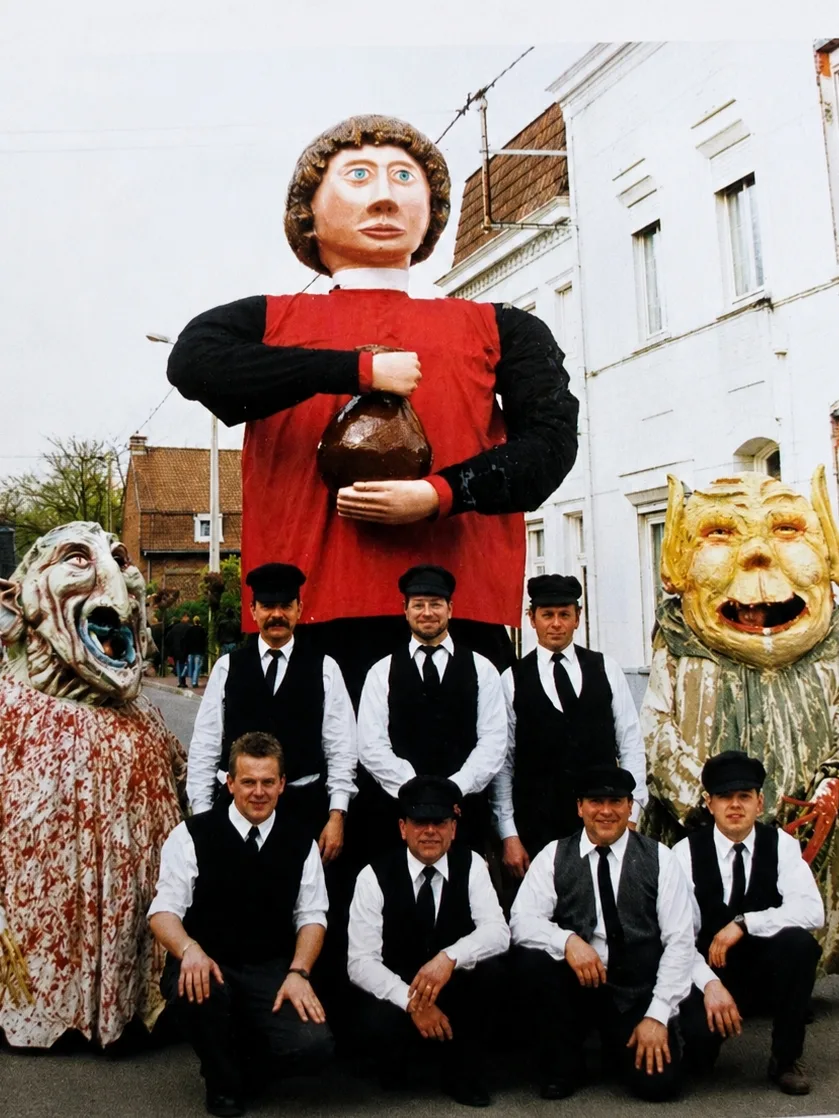
Rosalie 1994–2024

A website dedicated to the Giants of Steenvoorde, their history, their associations and the Summer Carnival.
© 2023 / 2026 – Steenvoorde and its Giants
Legal notices: Website hosted by planethoster.fr
Design: Pascal Cnockaert
Documentation and archives
The information presented on this website is based on public archives, historical publications, press articles, photographic collections, oral accounts and heritage resources relating to the history of Steenvoorde, its giants and its carnival.
Traduction automatique Deepl